
Last updated: August 31, 2026
Quick answer: For every 10 degrees Fahrenheit (about 5.5°C) above or below 75°F, your golf ball travels about 2 yards farther or shorter per club. That means a 250-yard drive at 75°F is about 254 yards at 95°F and 246 yards at 55°F. Air density does this — colder air is denser and creates more drag; warmer air is thinner.
If you play in one climate year-round, you don’t have to think about this much. If you play winter golf, or you travel from sea level to elevation, the numbers add up quickly and cost you strokes.
I tested this on my own launch monitor with actual chilled and heated golf balls to see whether ball temperature itself changes anything (spoiler: it doesn’t). Full data below, plus the temperature chart in both °F and °C so you can use it wherever you play.
Golf Ball Distance Temperature Chart (°F and °C)
Based on Andrew Rice’s Trackman research — roughly 2 yards per 10°F per club, using 75°F as the baseline reference:
| Temperature (°F) | Temperature (°C) | Change from 75°F baseline | 250-yard drive becomes… |
|---|---|---|---|
| 100°F | 38°C | +5 yards | ~255 yards |
| 90°F | 32°C | +3 yards | ~253 yards |
| 80°F | 27°C | +1 yard | ~251 yards |
| 75°F | 24°C | 0 (baseline) | 250 yards |
| 70°F | 21°C | −1 yard | ~249 yards |
| 60°F | 16°C | −3 yards | ~247 yards |
| 50°F | 10°C | −5 yards | ~245 yards |
| 40°F | 4°C | −7 yards | ~243 yards |
| 30°F | −1°C | −9 yards | ~241 yards |
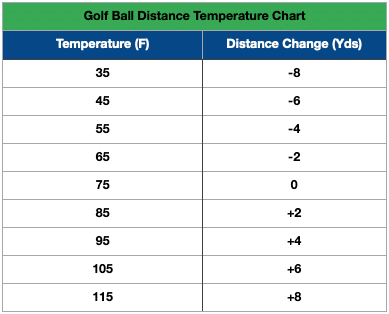
The rule of thumb: for every 10°F drop, you lose roughly 2 yards of carry per club — capping out around 2 yards per 10°F on driver-length shots. For a wedge, the loss is smaller in absolute terms because the shot is shorter to begin with. About 0.5-1 yard per 10°F on shorter irons.
75°F as the reference isn’t magic — Andrew Rice picked it because most golfers develop their yardage baselines during the middle of the golf season, when temperatures sit right around there. Whatever temperature you calibrate your yardages at becomes your personal baseline.
Why Cold Air Reduces Distance: Air Density Explained
Cold air is denser than warm air. The molecules pack closer together, which means a golf ball flying through cold air runs into more drag than the same shot in warm air. Less drag means the ball keeps its speed longer, which means more distance.
Warm air also rises, which is why you can feel the temperature difference between the ground floor and the upstairs of a house in summer. Golf balls are riding the same physics.
Air density depends on three things: temperature, humidity, and altitude. Temperature is the biggest of the three for practical golf, but altitude comes in a close second and humidity is a minor factor. See both below.
Related — smash factor and the best golf ball for your swing speed matter more than temperature for total distance.
Altitude and Elevation Effects
Altitude is the other atmospheric factor that changes distance meaningfully. Air is less dense at higher elevations because there’s less air column above you.
According to Andrew Rice’s Trackman research: you gain about 2.5 yards per 1,000 feet of altitude with a driver.
If you normally play at sea level and travel to Denver (5,280 feet), expect roughly 13 extra yards on driver carry. Playing at Mexico’s Club de Golf Chapultepec (~7,000 feet elevation)? That’s about 17 yards of extra carry.
The bigger point: at altitude, your entire yardage chart is wrong. Every club goes farther. You’ll fly greens with clubs that would land pin-high at sea level. Adjust — usually one club less per approach at 5,000+ feet, sometimes two clubs less on longer irons.
There’s also an interesting spin dynamic: the optimal driver spin rate rises with altitude, from about 2,250 RPM at sea level to about 3,000 RPM at 10,000 feet, because you need more hang time when the air is thin.
Humidity: The Counter-Intuitive Factor
Most golfers assume humid air is heavier because it feels heavier. Physics says the opposite.
Water molecules are lighter than the nitrogen and oxygen molecules that make up most of dry air. When you add water vapor to air, you’re actually reducing the average molecular weight. Humid air is slightly less dense than dry air at the same temperature.
The distance impact is small — maybe 1-3 yards over an entire round — but it goes in the opposite direction from what most golfers expect. On a humid day, you might carry slightly farther, not shorter. The reason humid weather feels like it’s costing you distance is usually about the ground getting soft (which kills roll) or your swing feeling sluggish (which is a body issue, not a ball issue).
Does Ball Temperature Itself Change Distance? My Launch Monitor Test
Here’s the part I was most curious about. Air temperature affects the ball because of drag. But does the temperature of the ball itself — the physical rubber, the core compression, the cover — change how far it flies?
I ran the test with a dozen new Vice Pro golf balls, divided into four groups:
Freezer group — sat in the freezer for 48 hours
Refrigerator group — sat in the fridge for 48 hours
Room temperature group — control at ~72°F
Heated group — warmed to approximately 120°F
I tested all four groups on a launch monitor with my driver, taking multiple shots per group at a consistent 109 mph swing speed.
The result: essentially no difference in distance. All four groups traveled about 305 yards on average. The variation between groups was within the normal shot-to-shot variance you’d expect from any launch monitor session.
The interesting part: the frozen balls felt completely different at impact. Harder, with a duller, more solid sound off the face. I actually pulled the driver back to check for damage after the first frozen shot because I thought something had cracked. Nothing was cracked — the ball just felt like hitting a rock. But the numbers were the same as the room-temperature balls.
Practical takeaway: leaving your golf balls in your car overnight in winter isn’t costing you distance. It might be costing you sound quality and feel, and I wouldn’t recommend it because the frozen ball is measurably harder on your club face, but the ball itself flying through the air performs the same at any ball-storage temperature.
The distance loss you experience in cold weather is coming from the air, not the ball.
How to Adjust Your Club Selection in Cold Weather
The chart above tells you the yardage change. Translating that into club choices during a round:
Above 85°F: you don’t need to adjust much. Add 1-3 yards to your typical club distances if you want to be precise, but most golfers can play their normal yardages.
60-75°F: your baseline range. Play your regular distances.
45-60°F: club up one on longer approaches (7-iron becomes 6-iron on the same shot). Your body is also less flexible in cool weather, so your swing might be a bit slower, compounding the distance loss.
Below 45°F: club up one on everything, sometimes two on longer approaches. Keep a spare ball warm in your pocket between shots — a cold ball off the face feels awful even if it flies the same distance. Layer clothing that doesn’t restrict your turn. Give yourself permission to swing within yourself.
Related — wedge distance control is the fastest way to know exactly how much to club up when the temperature moves. Also see launch monitor data for how the temperature interacts with launch angle and spin.
FAQs
How much does cold weather affect golf ball distance?
About 2 yards per club for every 10°F below 75°F, based on Andrew Rice’s Trackman research. So a 250-yard driver at 75°F is about 246 yards at 55°F, and roughly 241 yards at 30°F.
Does temperature actually affect a golf ball, or just the air?
It’s the air. I tested chilled and heated balls side by side on a launch monitor and saw no meaningful distance change. The distance loss in cold weather comes from denser air creating more drag, not from anything happening to the ball itself.
What temperature is best for golf?
Around 75°F is the reference point most club-distance charts are calibrated to. Temperatures between 70-85°F give you your baseline distances. Above or below that range, your yardages start to drift.
Does altitude affect golf ball distance more than temperature?
Altitude effects can be bigger. Every 1,000 feet of elevation gives you about 2.5 yards more on driver. Playing at 5,000 feet vs sea level is a bigger yardage swing than playing 75°F vs 40°F.
Should I keep my golf balls warm in winter?
The ball itself doesn’t fly shorter when cold, so it doesn’t affect distance. It does feel and sound different at impact — harder, duller. If the feel bothers you, keeping a spare ball in your pocket between shots keeps it comfortable. Not required.
Final Thoughts
Temperature and altitude affect ball distance. Ball temperature doesn’t. Humidity slightly helps rather than hurts. These are small effects individually, but they add up over 18 holes.
If you’re a fair-weather golfer, like I am, you probably won’t notice most of it. If you play through November-March in a cold climate, or you take a golf trip to a mountain resort, this stuff matters enough to plan around.
Good luck on the golf course!