
Last updated: August 31, 2026
Quick reference: A circle around your score means birdie. A square means bogey. Double circle is eagle, double square is double bogey. Full symbol legend below, plus how to read the rest of a golf scorecard — par, handicap, slope rating, and course rating.
New golfers usually figure out par pretty quickly. The circles, squares, and other markings on the scorecard take a bit longer. And there’s a lot more information on a scorecard than most casual golfers realize — slope rating, course rating, per-hole handicap, tee-box yardages, and the local rules printed on the back.
Here’s the full guide, starting with the symbols since that’s what most people are looking for.
Golf Scorecard Symbols Reference Table
| Symbol | Meaning | Score example |
|---|---|---|
| No symbol | Par | 4 on a par 4 |
| Single circle | Birdie — 1 under par | 3 on a par 4 |
| Double circle | Eagle — 2 under par | 3 on a par 5 |
| Triple circle | Albatross / double eagle — 3 under par | 2 on a par 5 |
| Single square | Bogey — 1 over par | 5 on a par 4 |
| Double square | Double bogey — 2 over par | 6 on a par 4 |
| Triangle | Triple bogey (some scorers) OR an ace (others) | Depends on convention |
| Dot beside score | Handicap stroke — net scoring | One dot = −1 net |
What Each Symbol Means
Circle = Birdie (1 under par)
A single circle drawn around your score means you finished the hole in one stroke less than par. On a par 4, that’s a 3. On a par 5, that’s a 4. Birdies are the most common under-par score for amateurs and the most satisfying to write on the card.
Getting a birdie usually means one of two things: a great approach shot that set up a close putt, or a long putt that dropped. Either way, it’s worth the extra pencil stroke to circle the number.
Double Circle = Eagle (2 under par)
Two circles around your score means an eagle — 2 under par. That’s a 2 on a par 4 (usually holing your approach shot), a 3 on a par 5, or a hole-in-one on a par 3. The double circle is rare enough that most amateurs go entire seasons without drawing one.
A hole-in-one is technically an eagle on a par 3, but most golfers give it its own recognition. If you get one, the double circle understates what happened.
Triple Circle = Albatross (3 under par)
Three circles means an albatross, sometimes called a double eagle. That’s an ace on a par 4 (extremely rare) or a 2 on a par 5 (also extremely rare). If you draw three circles around a score, save the scorecard. Most golfers never get one in their lifetime.
Square = Bogey (1 over par)
A square around your score means bogey — 1 over par. On a par 4, that’s a 5. Bogey is the most common over-par score for amateur golfers, and a scorecard full of bogeys and pars is a solid round for most players.
If you’re a bogey golfer, you can shoot 90 on a par-72 course by bogeying every hole. That’s a real accomplishment — see what percent of golfers break 90 for the actual numbers.
Double Square = Double Bogey (2 over par)
Two squares means double bogey — 2 over par. Usually the result of one big mistake per hole: a penalty stroke, a chunked chip that had to be replayed, or three putts from bad position. On a par 4, that’s a 6.
Doubles happen. The important thing is not to let them stack. One double doesn’t wreck a round; two or three in a row can.
Triangle = Triple Bogey (or Ace, depending on convention)
The triangle is where scoring conventions actually disagree.
Most players use a triangle to mean triple bogey (3 over par) or worse. Some use it to mark an ace on a par 3. There’s no universal rule.
Practically, once you’re worse than a double bogey, most scorers just write the raw number without a symbol. It’s clearer than trying to figure out which convention your playing partner uses.
Dots = Handicap Strokes (net scoring)
Dots next to a hole number indicate net-scoring adjustments in a handicap-based competition. One dot means you get 1 stroke on that hole. Two dots means 2 strokes.
Which holes get dots depends on your handicap and the hole’s stroke-index rating. If you’re a 12 handicap, you get dots on the 12 hardest holes (stroke indexes 1-12). If you’re a 22 handicap, you get 1 dot on the 14 easier holes and 2 dots on the 4 hardest.
Match play and net-scoring events are where dots matter most. Casual rounds usually skip them.
App vs Paper Scorecard: Symbol Differences
If you keep score in a phone app instead of on paper, the symbols shift a little.
GHIN Mobile (the USGA’s official app) uses the same symbols as paper — circles for under par, squares for over par.
Golf Pad GPS uses solid circles for eagle-or-better and solid squares for double-bogey-or-worse, condensing the “multiple shape” convention.
Golfshot, 18Birdies, TheGrint each have their own visual conventions.
If you use a specific app regularly, spend 5 minutes looking at the scoring legend in the settings. It matters more in competition play than casual rounds, but knowing which symbol means what on your phone saves confusion.
A Real Scorecard, Walked Through
Symbols are the fun part. The rest of the scorecard has information that actually affects your strategy on the course. Here’s a scorecard from a course I play regularly, walked through section by section.
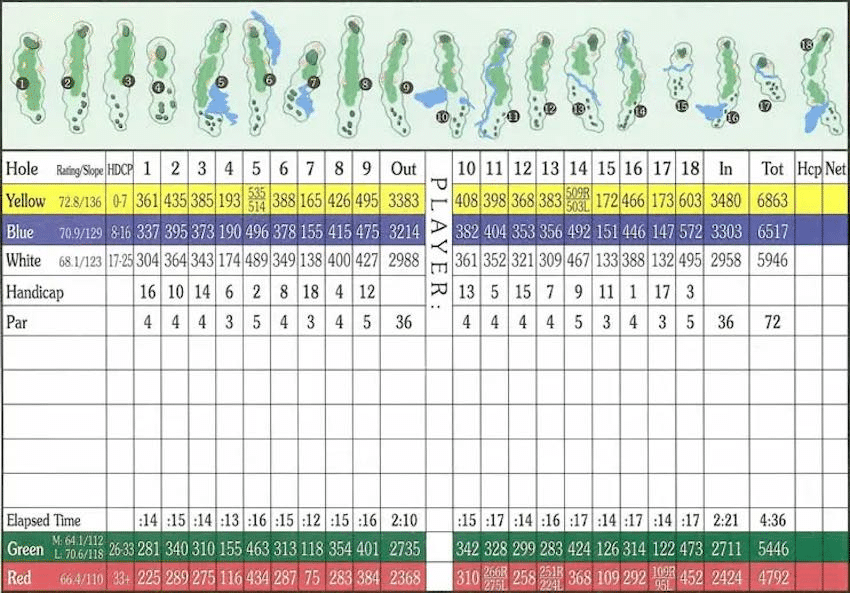
Every scorecard has the same core sections: tees and yardages, par per hole, handicap per hole, and slope/course rating. Some courses add hole overviews, local rules, and space for signatures.
Tees and Yardages
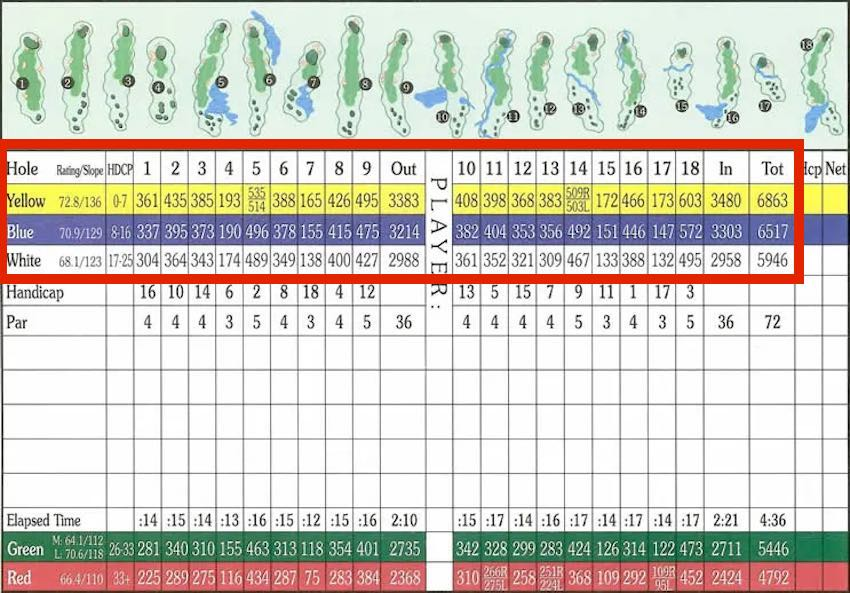
Most golf courses have 3-5 sets of tees, labeled by color. A scorecard shows the yardage from each tee to the green, for every hole.
On this course you can see yellow tees, blue tees, white tees, green tees, and red tees. Hole 1 is 361 yards from the yellow tees and 337 from the blue.
Common tee colors: gold (championship / “the tips”), blue, white, yellow, red, green. Which color you play from should match your driving distance and skill level, not your gender. “Men’s tees” and “ladies’ tees” are outdated labels. If your driver goes 200 yards, the 6,500-yard tees are going to make golf miserable regardless of who you are.
“Playing from the tips” means you’re on the longest set of tees. That’s where scratch golfers and pros play. For everyone else, it’s usually a punishing choice.
Par for Each Hole
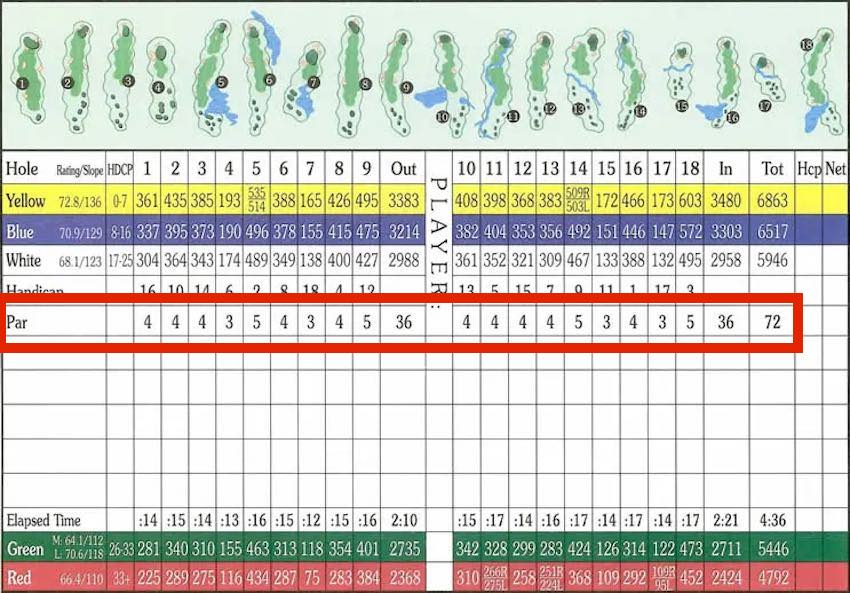
Par is the number of strokes a skilled golfer is expected to take on a hole. Par 3s are short holes reachable with one shot. Par 4s are mid-length, taking a tee shot and an approach. Par 5s are longer, giving you three shots to reach the green.
On this scorecard, holes 1-3 are par 4s and hole 4 is a par 3. Total par is 36 out, 36 in, 72 for the round.
Handicap Number per Hole (Stroke Index)
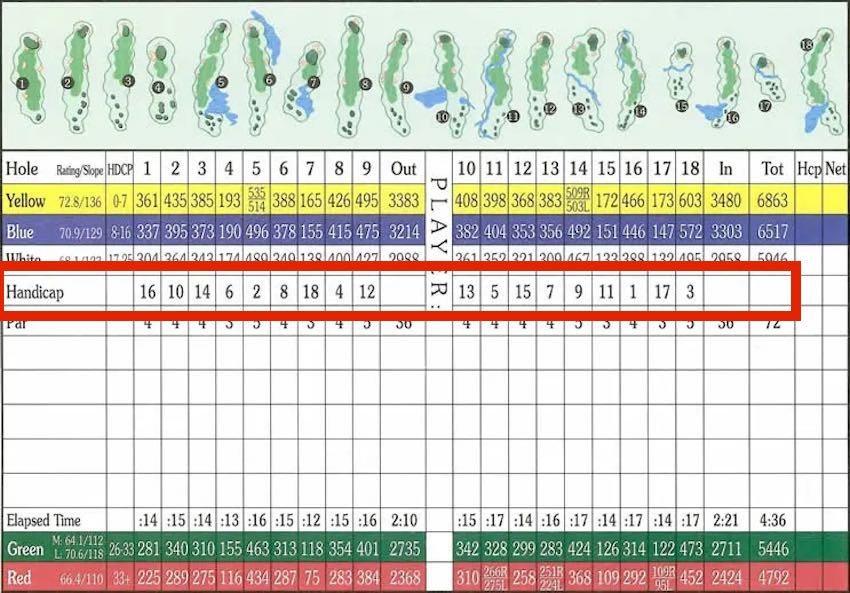
Every hole has a handicap number from 1 to 18, indicating how difficult the hole is relative to the rest of the course. Hole 1 (as a stroke index, not necessarily the first hole you play) is the hardest. Hole 18 is the easiest.
The stroke index is what determines where you get handicap strokes in net-scoring play. It’s calculated using distance, obstacles, green complexity, and fairway width.
Worked example: if you’re a 4 handicap in a match play round, you’d receive one stroke per hole on the 4 hardest holes (stroke indexes 1, 2, 3, 4). So your expected score is bogey on those holes and par everywhere else, giving you a par-round net score.
Related — how to calculate a golfer’s handicap.
Slope Rating and Course Rating
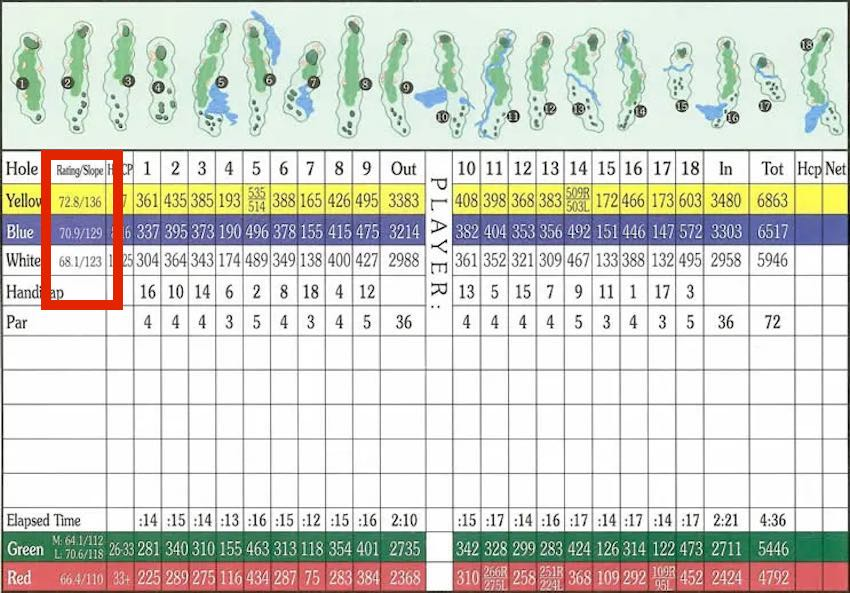
Two numbers, usually printed together as something like “72.1/135”. These are used by the handicap system.
Course rating is the expected score of a scratch (0-handicap) golfer on that course from those tees. A course rating of 72.1 means a scratch golfer would average 72.1 strokes.
Slope rating is a measure of how much harder the course plays for higher-handicap golfers compared to scratch golfers. USGA sets the “standard” slope at 113. Higher numbers mean the course punishes bogey golfers more. The scale runs from 55 to 155.
Some of the hardest golf courses in the world carry a 155 slope rating — the maximum. If you play a 155-slope course, expect your handicap to work harder for you than it would on your home track.
You only really need to know slope and course rating if you’re tracking a handicap or playing an away round with handicap adjustments.
Tracking More Than Just Score
The scorecard has enough blank space to track more than just strokes per hole. Here’s what my scorecard looks like after a round:
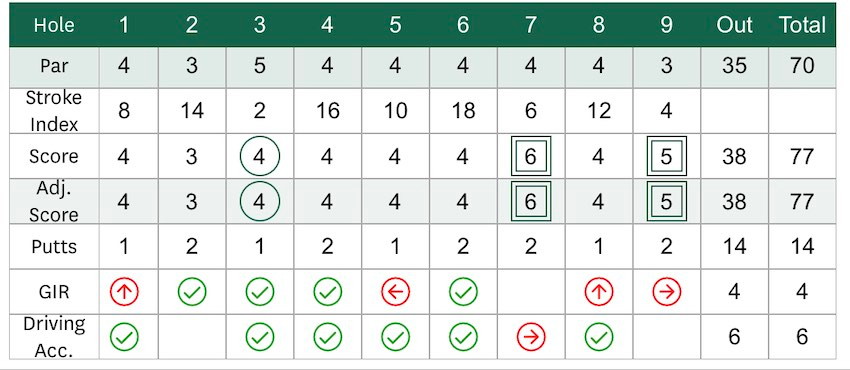
What I’m tracking on this card:
Score with symbols: circle for birdie on hole 3, double square for the double bogeys on holes 7 and 9.
Putts per hole: small number below the score.
Fairway hit: ✓ if I hit the fairway off the tee, small red arrow left or right if I missed and in which direction. On par 3s I skip this since driver accuracy isn’t relevant.
Greens in regulation: ✓ if I reached the green in par-minus-2 strokes (2 shots on a par 4, 3 shots on a par 5).
Tracking these numbers over a few rounds tells you exactly where you’re losing strokes. If you’re hitting 50% of fairways and 20% of greens, your issue is probably tee-shot accuracy. If you’re hitting 70% of fairways and 20% of greens, your iron game needs work.
You can also track your mental game — focus, confidence, and response after mistakes. Check the full article on keeping a golf mental scorecard for that framework.
I use the GHIN Mobile app for tracking these stats digitally now, but a paper card and pencil works just as well. Whichever you prefer.
FAQs
What do the shapes mean on a golf scorecard?
Circles are for scores under par (birdie, eagle, albatross). Squares are for scores over par (bogey, double bogey, worse). The number of shapes matches how far under or over par you went. See the reference table above.
What does a square mean on a golf scorecard?
A single square around your score means a bogey — 1 stroke over par on that hole. A 5 on a par 4, a 4 on a par 3, or a 6 on a par 5.
What does a circle mean on a golf scorecard?
A single circle around your score means a birdie — 1 stroke under par. A 3 on a par 4 or a 4 on a par 5.
What is a triangle on a golf scorecard?
A triangle typically means a triple bogey (3 over par) or worse. Some players use it to mark a hole-in-one instead. There’s no universal convention — most players just write the raw number for scores worse than a double bogey.
What are the dots on a golf scorecard?
Dots are handicap-stroke markers used in net-scoring competitions. One dot means you receive 1 stroke on that hole; two dots means 2 strokes.
How do you read a golf scorecard?
Start with par per hole. Add up your strokes for each hole. Mark birdies with a circle, bogeys with a square. Total the front nine, back nine, and full round. In competition play, also account for handicap strokes based on the stroke index and dots.
What happens if you sign the wrong scorecard?
In a competitive event, signing a scorecard with a lower score than you actually shot gets you disqualified. Signing a higher-than-actual score means you have to accept the higher score. This is why you double-check the totals before signing.
Final Thoughts
Scorecards look simple until you actually look at them. Between symbols, per-hole handicap, slope rating, and stroke index, there’s a lot of information packed onto a small piece of card stock.
The good news is that once you know what everything means, keeping score gets easier and more useful. Tracking putts, fairways, and greens on the same card turns a scorecard into a rough diagnostic of your round.
If you have questions about anything specific on your local course’s card, hit me on Twitter or email Bigteesgolf@gmail.com.
Good luck on the golf course!