
Last updated: September 4, 2026
⛳️ Our experts spend hours gathering data, testing, and comparing products to deliver comprehensive recommendations to help you choose. When you make a purchase through one of our links, we may earn a small affiliate commission, at no cost to you. Find out more about how we test products.
Quick Verdict: Which Speed Trainer Wins in 2026?
I’ve used both the Stack System and SuperSpeed for real training blocks and have hands-on experience with Rypstick. In 2026 the speed-trainer category is a 3-horse race — SuperSpeed (~$149) is the cheapest, Rypstick ($199) splits the difference on price and features, and the Stack System ($299) is the most expensive but also the most data-driven. Bottom line: Stack System is best if you want structured, app-guided training with real progress tracking and both overload + overspeed work in one product. SuperSpeed is best if you want the lowest cost of entry and you’re disciplined enough to track your own progress. Rypstick is the middle option — driver-length feel with adjustable weights and an app. All three work; the question is which one matches how you actually practice.
Pricing at a Glance (2026)
| Product | Base Price (2026) | App / Guidance | Deal / Code |
|---|---|---|---|
| Stack System | $299 (club + weights) +$200 optional launch radar | Yes — iOS app included, 2 years free | 10% off with code BIGTEESGOLF |
| SuperSpeed | $149 (3-stick set) | No app — video protocols only | Occasional manufacturer discounts |
| Rypstick | $199 (single-club, adjustable weights) | Yes — RYP app included | 40-day money-back guarantee |
Feature-by-Feature: Stack vs SuperSpeed vs Rypstick
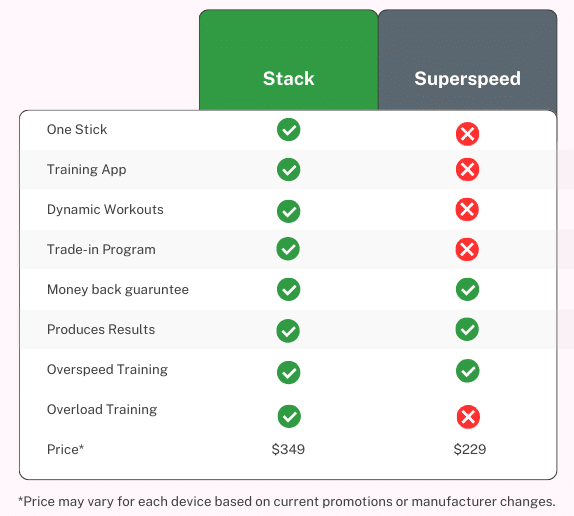
| Feature | Stack System | SuperSpeed | Rypstick |
|---|---|---|---|
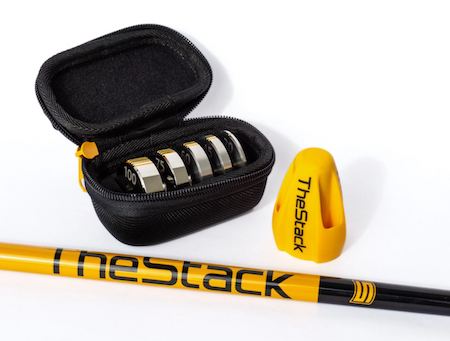
| Physical design | 1 adjustable club + 5 milled weights | 3 fixed-weight sticks (light, medium, heavy) | 1 adjustable club (~5-8 weight settings) |
| Length | 42″ (~7-iron length) | Driver length | Driver length (~45″ mens) |
| Weight combinations | 30 (from 0g to 300g) | 3 (fixed) | 5-8 (adjustable) |
| Overload training | Yes | No | Limited |
| Overspeed training | Yes | Yes | Yes |
| App | Yes (iOS only, 2 years free) | No (video protocols) | Yes (RYP app) |
| App-guided workouts | Step-by-step, adjusts to your data | N/A | Yes |
| Voice-recognition data entry | Yes | No | No |
| Family sharing | Up to 20 users per Stack | N/A | Individual accounts |
| Sizing options | Junior + adult | Men / Women / Senior | Men / Women / Senior / Junior / Indoor |
| Trade-in program | Yes — $100 off with eligible trade-in | No | No |
| Money-back guarantee | 30 days | 30 days | 40 days |
The biggest structural difference: only the Stack does both overload and overspeed training in a single product. SuperSpeed is overspeed-only (that’s its philosophy — three progressively lighter sticks). Rypstick is closer to Stack in that it can be weighted heavier or lighter, but not with anywhere near the granularity Stack’s 30 weight combinations allow.
The Stack System: What Works, What Doesn’t
The Stack System was co-developed by Dr. Sasho MacKenzie (biomechanics PhD, one of the leading voices in golf swing physics) and Marty Jertson (PGA of America player and VP of Fitting at PING). The design philosophy is measured, data-driven speed training that adapts to your individual results.
My own experience: I gained 7 mph of clubhead speed with the Stack (109→116 mph peak, still working toward 120+). That’s a 20+ yard distance gain, and I’m still using it. Full detail in the Stack System review.
✅ Stack Pros
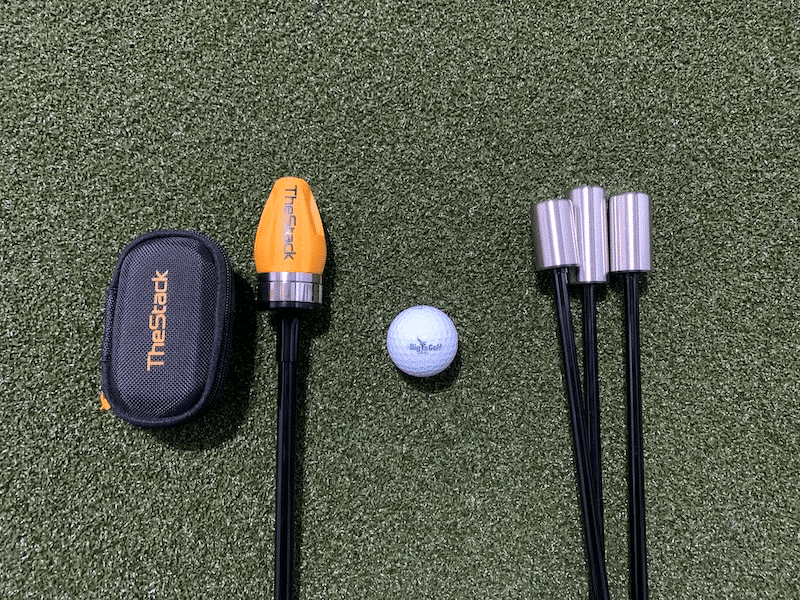
- Single-club design with 30 weight combinations (0-300g)
- Junior + adult sizes
- 2 years of free app access included with purchase
- App walks you step-by-step through each workout
- App dynamically adjusts your workouts based on your actual performance
- Voice-recognition data entry (hands-free between reps)
- Family sharing — up to 20 users per Stack
- Progress tracking with objective metrics
- Trade-in program: $100 off with an eligible speed trainer trade-in
- 30-day money-back guarantee
- Optional Stack Pro launch radar for direct speed measurement
- Both overload and overspeed training in one product
❌ Stack Cons
- App is iOS-only (Android users need an iPad or iPhone)
- Higher entry price — $299 base, $499 with launch radar
- 42″ length is shorter than a driver (~7-iron length), which some players find gives less “driver feel”
- Requires more commitment than a simple 3-stick swing-and-count protocol
Enjoy 10% off with
Code: BIGTEESGOLF
SuperSpeed: What Works, What Doesn’t
SuperSpeed Golf was the original speed-training protocol to hit the mainstream — the 3-stick set (green light, blue medium, red heavy) built on the principle that swinging a lighter club faster than you can swing your regular driver trains your body to move at higher speeds. It works. Bryson DeChambeau publicly credited a SuperSpeed protocol for early distance gains in his career. Simple, low-cost, and effective for the overspeed piece.
✅ SuperSpeed Pros
- Lowest entry price ($149) of the three trainers
- Driver-length feel — the swing motion closely matches your real driver swing
- Simple 3-stick system with clear light/medium/heavy progression
- Voice-recognition capability via app (though app is optional)
- 30-day money-back guarantee
- Proven track record — used by PGA Tour players including Bryson DeChambeau in his distance-building phase
- No commitment to a specific ecosystem — just swing the sticks
❌ SuperSpeed Cons
- Overspeed only — no overload training with the stock 3-stick set
- No app-guided workout progression; you follow videos and self-track
- No objective progress tracking built in
- Fixed weights — no adjustment beyond the 3 stick options
- Requires more self-discipline to structure your own training and measure results
Rypstick: What Works, What Doesn’t
Rypstick was developed by Dr. Luke Benoit and hit the market as the “middle-ground” between the simplicity of SuperSpeed and the data-density of Stack. Single adjustable club, driver-length, comes with the RYP app for guided training. See my full Rypstick review for a deeper dive.
✅ Rypstick Pros
- Single-club design with adjustable weights (5-8 settings)
- Driver-length — matches real swing feel
- Multiple sizing options: Men, Women, Senior, Junior, and Indoor variants
- Comes with RYP app for guided workouts
- 40-day money-back guarantee (longest in the category)
- Mid-priced at $199 — between SuperSpeed and Stack
❌ Rypstick Cons
- Fewer weight combinations than Stack (5-8 vs 30)
- Overload training is limited — the weight range is narrower than Stack’s
- App workout progression is less adaptive than Stack’s data-driven adjustments
- No voice-recognition data entry
- Newer product with less long-term Tour-player validation than Stack or SuperSpeed
Overload + Overspeed: Why Stack Is the Only One That Does Both
There are 4 main components to increasing your swing speed: Speed, Flexibility, Strength, and Mechanics. Speed training touches the first component directly. The two critical training modes within Speed training are:
- Overspeed: swinging a lighter club faster than your normal driver, training your central nervous system to move faster. All three trainers do this.
- Overload: swinging a heavier club slower than your normal driver, building the specific-strength and grooving the motion for your body to move heavier objects. Only Stack (natively) and Rypstick (to a limited extent) do this — SuperSpeed’s stock 3-stick set does not.
The best speed-training research (much of it from Dr. Sasho MacKenzie’s own biomechanics work) points to overspeed + overload combined as more effective than either alone. That’s why Stack’s 30-weight-combination design isn’t a gimmick — it’s what the science says produces the biggest speed gains. SuperSpeed’s overspeed-only protocol still works, but you’re missing half the training stimulus.
Related — Estimate your current swing speed with this calculator
The Length Question: Why Stack Is Shorter Than a Driver
Common criticism of the Stack System — the club is 42″ (7-iron length), not driver length. SuperSpeed and Rypstick are both driver-length. Doesn’t that mean Stack trains the wrong feel?
The Stack team’s answer: 42″ is intentional, and it’s based on Sasho MacKenzie’s biomechanics work. A shorter shaft creates a lower moment of inertia, which lets you accelerate the clubhead faster during training reps without straining your body — the speed gain transfers to your driver even though the training tool is shorter. Elite trackers show consistent speed transfer from Stack training to on-course driver speed. Multiple Tour players (Matt Fitzpatrick most notably) use the Stack for exactly this reason.
Honest take: the length criticism is real if your feel-matters instinct is strong. Driver-length trainers (SuperSpeed, Rypstick) do give you the swing feel of a real driver. But if the question is “which produces the biggest speed gain?”, the science favors Stack’s shorter-shaft-plus-overload design. My own 7 mph gain came from Stack; that’s not a placebo.
The 2024 Lawsuit: SuperSpeed vs Stack
Worth mentioning for context: in May 2024, SuperSpeed Golf filed a lawsuit against The Stack System for false advertising, alleging Stack made misleading claims about speed-training efficacy. MyGolfSpy covered the news in detail, and the golf-tech industry reacted with skepticism about both sides — SuperSpeed’s claim felt defensive to some observers, and Stack’s marketing language was arguably aggressive. The suit was working through the courts as of 2025 with no public resolution that materially changes what either product does.
For buyers: this doesn’t change which product is right for you. Both companies are still selling their products, both product designs still work, and neither is being pulled from the market. The lawsuit is about marketing claims, not product quality. Worth reading the coverage if you want to be fully informed, but don’t let it flip your buying decision on its own.
My Own Speed Gains: The Numbers
The Stack gave me a measured 7 mph gain in clubhead speed over consistent training — from around 109 mph up to 116 mph peak. In real terms that’s about 20 additional yards of carry off the tee. Not one-and-done: I’m still using it, still tracking metrics, and still aiming to push past 120 mph.
Full training log and the specific weekly protocol I used are in my 3-year Stack System review. If you’re evaluating whether the Stack investment is worth $299 for you, that’s the honest data.
What Users Are Saying (Reddit)
“Been using the Stack for about 6 months now. Went from 105 mph to 114 mph. The app is legitimately good — walks you through everything and adjusts based on your data. My only complaint is it’s iOS only, which is annoying if you’re an Android user.”
– Reddit
“SuperSpeed works fine and is way cheaper. If you’re disciplined enough to track your own progress, you don’t need the Stack. If you’re not, the Stack app basically does the thinking for you.”
– Reddit
Both of these are fair takes. The Stack’s app is what elevates it above SuperSpeed for most golfers — it does the work of structuring a training plan and adjusting it as you get faster. If you’re the type who will build your own progressive training program without help, SuperSpeed is enough.
Stack System — Reasons to Avoid
The Stack isn’t for everyone. Skip it if any of these are true:
- You want to spend under $200. Even with the 10% BIGTEESGOLF code, the Stack lands around $270 base. SuperSpeed at $149 or Rypstick at $199 will hit your budget better.
- You don’t own an iOS device. The Stack app is iOS-only. You can buy a refurbished iPad for cheap to work around this, but if that’s a dealbreaker, SuperSpeed or Rypstick.
- You don’t want a structured practice routine. The Stack app assumes you’ll follow its progressive workouts. If you want a free-form “swing when I feel like it” tool, this isn’t it.
- You value driver-length feel above all. The 42″ length is a real trade-off if that specifically matters to you.
SuperSpeed — Reasons to Avoid
SuperSpeed isn’t for everyone either. Skip it if:
- You won’t self-track your progress. Without objective data on speed gains, you’re guessing based on ball flight — which is unreliable. Ideally pair SuperSpeed with a portable swing-speed radar like the PRGR (~$249), which pushes the total investment above the Stack base price anyway.
- You want app-guided workouts. SuperSpeed provides video protocols but no dynamic workout tracker. You do the structuring yourself.
- You want overload work. The stock 3-stick set is overspeed only. Adding overload requires buying separate weighted clubs.
- You want the deepest speed-training science. SuperSpeed works, but the research edge is on Stack’s overload+overspeed combined approach.
Frequently Asked Questions
Which speed trainer is best for me — Stack, SuperSpeed, or Rypstick?
Stack if you want the most data-driven training and are willing to invest $299+. SuperSpeed if you want the cheapest entry ($149) and are disciplined enough to self-track. Rypstick if you want driver-length feel with an app for around $199 — the middle-ground option. All three work; the fit depends on your budget and how much structure you need.
Can you use Stack and SuperSpeed together?
Technically yes, but there’s no reason to. Both target the same neurological adaptation. Pick one and follow its protocol consistently. Splitting time between two systems reduces the specificity of the training stimulus and probably slows your gains.
How long does it take to see swing speed gains?
Most players see 2-4 mph gains in the first 4-6 weeks of consistent training (3-4 sessions per week). Bigger gains — 5-10 mph — usually come over 3-6 months. My own 7 mph came over about 6 months of consistent Stack work. Faster gains happen if you’re starting from a low base or if your mechanics improve alongside the speed work.
Is speed training safe for older golfers?
Yes, with sensible progression. The Stack has junior + adult sizing; SuperSpeed offers Senior/Women variants with lighter starting weights; Rypstick has a Senior variant too. Warm up properly, ease into higher weights, and stop if anything hurts. The overload component (heavier weights) is what puts more strain on the body — start light and build up.
Does the Stack System work on Android?
The Stack app is currently iOS-only. Android users need to use an iPad or iPhone to run the app. A refurbished iPad Mini is $100-150 if this is a dealbreaker but you still want the Stack. Or pick SuperSpeed / Rypstick, which don’t have this restriction.
Final Thoughts
Speed training works — real speed gains, real distance gains, all three of these products deliver if you commit to the training. My own bias, transparently: I gained 7 mph with the Stack, I still use it, and I have an affiliate arrangement (10% off with code BIGTEESGOLF). The Stack is my top recommendation and the data + app combination is genuinely differentiated.
That said — if $299 is more than you want to spend, SuperSpeed at $149 is a real product that will move the needle if you commit to the protocol. And Rypstick at $199 is a legitimate middle-ground pick if you want the driver-length feel with an app included.
Whichever you pick, put in the reps. The best speed trainer is the one you actually use consistently for 3+ months. Good luck out there.
Ready to add speed?
10% off with code BIGTEESGOLF
Related content: 3-Year Stack System Review | Rypstick Review | Best Swing Speed Trainers | Swing Speed Calculator | How to Increase Golf Swing Speed | PRGR Launch Monitor Review