
Last updated: August 31, 2026
Quick answer: About 55% of golfers regularly break 100, roughly 26% break 90 on a consistent basis, and only about 4% break 80. The percentages depend heavily on how you define “golfer” — whether you’re counting active handicappers, casual players, men, or women. Here’s the full breakdown.
Breaking a score threshold — 100, 90, or 80 — is one of the clearest ways to measure your progress. Each one is a real milestone that separates casual players from more serious ones.
I’ve been working through these thresholds myself. At the start of the 2022 season I was a 16 handicap. Through 2023 I dropped to an 11, and by the end of the season I got down to a 7. Consistently breaking 90 now, often breaking 80. Getting to a 4 is next on the list.
If you’re reading this, you probably want to know where you stand and what it takes to move up. Let’s start with the highest-volume question first.
What Percent of Golfers Break 100?
Depending on which source you look at, the answer is somewhere between 55% and 95%.
Two different bodies of data give two different numbers:
USGA data (golfers with active handicap indexes): 94.81% of men and 49.89% of women break 100 at least occasionally.
National Golf Foundation data (attempts to include all golfers, including casual players): about 55% consistently break 100.
Both are true. The gap between them is a methodology story that most articles ignore — see the “Why the Numbers Vary” section below.
The practical takeaway: if you’ve been playing regularly for a year or two and you’re not breaking 100 yet, you’re not alone. Most casual golfers spend a long time in the triple digits.
Related — How to calculate a golfer’s handicap
What Percent of Golfers Break 90?
USGA data: 70.44% of men and 21.11% of women break 90.
National Golf Foundation data: about 26% of golfers regularly break 90.
Breaking 90 is the middle threshold and it’s where the biggest skill jump lives. Getting from bogey golf (regularly shooting the mid-90s) to consistently breaking 90 requires more than just fewer blowup holes — it requires consistency across 18 holes.
The 15-handicap player who breaks 90 with any regularity typically has:
Around 50% fairways hit
About 25% greens in regulation
Roughly 32 putts per round
No more than 4 double bogeys or worse per round
If your stats look worse than that, breaking 90 is a stretch. If they’re better, you’re probably breaking 90 already.
What Percent of Golfers Break 80?
USGA data: 20.08% of men and 3.24% of women break 80.
NGF estimates: closer to 4-10% of all golfers.
Breaking 80 is where serious golfers separate from the pack. Most amateur golfers — even ones who play regularly — never get here. It requires a level of ball striking, course management, and putting that takes years of intentional practice to build.
The players I know who break 80 regularly all have a few things in common. They play at least once a week. They practice with purpose — not just hitting balls. And they’ve had a lesson or fitting at some point that fixed something specific in their swing.
What Percent of Golfers Break 70?
Under 2%. Roughly 1.5-2% of male golfers with active handicaps ever break 70. For female golfers, less than 1%.
Breaking 70 is what elite amateurs and low single-digit handicappers do. If you’re aiming for it, you’re in territory where equipment, fitness, and swing mechanics all have to align.
Percent of Golfers by Threshold — At a Glance
| Score threshold | USGA (men) | USGA (women) | NGF estimate (all golfers) |
|---|---|---|---|
| Break 100 | 94.81% | 49.89% | ~55% |
| Break 90 | 70.44% | 21.11% | ~26% |
| Break 80 | 20.08% | 3.24% | ~4-10% |
| Break 70 | ~2% | <1% | <1% |
Why the “Percent of Golfers” Numbers Vary So Widely
This is the piece most articles don’t explain, and it’s the whole reason you’ll see 55% in one place and 94% in another.
USGA data measures golfers who maintain an official handicap index. That’s only about 10-15% of Americans who play golf in a given year. The people who carry handicaps play more, practice more, and take the game more seriously — so they score better on average. When the USGA reports “70% of men break 90”, it means 70% of the handicap-carrying subset, not 70% of everyone who’s ever picked up a club.
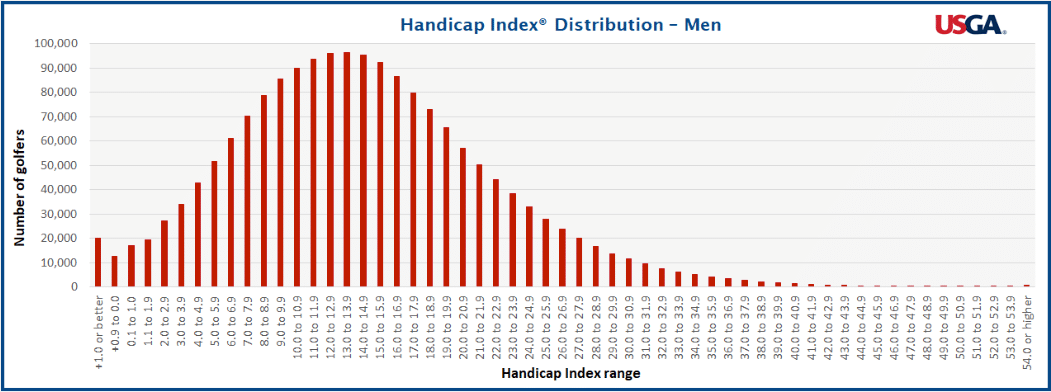
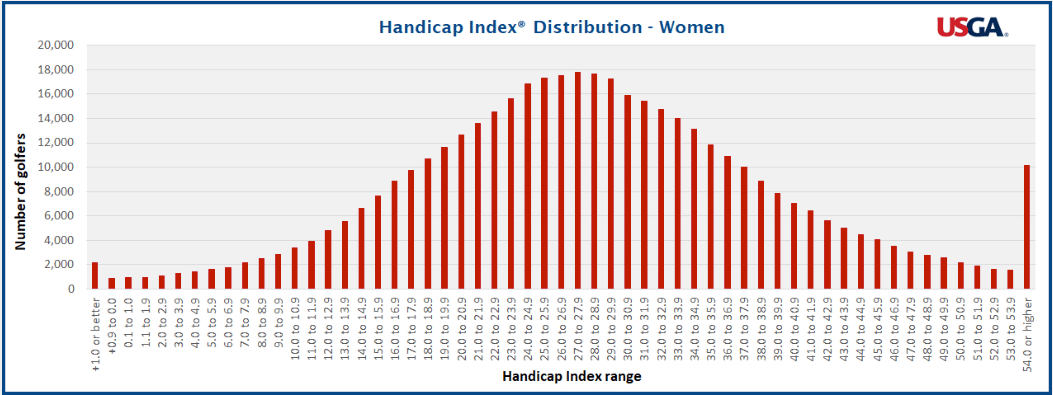
National Golf Foundation data attempts to include casual golfers — the once-or-twice-a-month player who’s never posted a score for handicap purposes. When you factor those players in, the percentages drop hard. The NGF figure of ~55% breaking 100 consistently is closer to the “all golfers” reality.
Neither is wrong. They just answer different questions.
If you want to know how good you are compared to serious golfers, use the USGA numbers. If you want to know how good you are compared to everyone who plays, use the NGF numbers. This article shows both because most of us fall somewhere in between.
Men vs Women: Where the Gap Is
The gender gap in these thresholds is substantial:
45 percentage points on breaking 100 (USGA data)
49 percentage points on breaking 90
17 percentage points on breaking 80
Most of that gap traces back to distance off the tee. Average male drive is around 220 yards; average female drive is around 150 yards. On a par-72 course designed for men’s tees, that turns nearly every par 4 into what would effectively be a par 5 for many female players.
Some clubs have started offering forward tees specifically to level out par relative to typical female driving distance. If you’re a woman working on breaking a threshold and your course has multiple tee options, playing from a set that gives you a realistic approach-shot distance makes a real difference.
How to Move Up a Tier
I’ve had my own experience working through the thresholds recently. Here’s what actually moved the needle for me.
From 16 to 11 handicap (breaking 90 more regularly): The single biggest change was wedge distance control. I built my own wedge matrix with specific yardages for half swings, three-quarter swings, and full swings across my sand wedge, gap wedge, and pitching wedge. Being able to hit a specific number from 100 yards and in cut strokes faster than anything else.
From 11 to 7 handicap (breaking 80 more often): Swing speed training with the Stack System added about 7 mph to my easy-swing driver clubhead speed. That translates to roughly 20 yards more distance off the tee. Shorter approach shots means more greens in regulation, which means fewer par saves and more birdie chances.
From 7 toward 4: Working on this now. The focus is putting from 6-12 feet. That’s where the top 5% separates from the top 20%.
Your path may be different. The general principle: figure out the one part of your game that’s costing you the most strokes, and attack that. If you’re losing balls off the tee, work on driver accuracy. If you’re taking 40 putts a round, work on putting. If you three-putt from inside 10 feet regularly, that’s the fix.
Related — What is the average golf handicap
FAQs
What percentage of golfers actually break 100?
About 55% of all golfers regularly break 100, per National Golf Foundation data. Among golfers with active USGA handicap indexes, roughly 94.81% of men and 49.89% of women break 100 at least occasionally.
What percent of golfers can break 90?
About 26% of all golfers regularly break 90. USGA handicap data shows 70.44% of men and 21.11% of women break 90.
What percentage of golfers will break 80?
USGA data shows 20.08% of men and 3.24% of women break 80. Including all golfers (casual players and non-handicappers), the number is closer to 4-10%.
How many golfers break 70?
Roughly 2% of male golfers with handicaps break 70, and less than 1% of female golfers.
How long should it take to break 100 in golf?
If you’re new to the game, taking regular lessons and practicing intentionally, 6-12 months is realistic. Playing casually with no practice, it can take 2-3 years.
What does the average recreational golfer score?
The average score for men is around 97 (USGA-handicapped) or higher for casual players. The average for women is around 108.
Final Thoughts
Golf scoring numbers get quoted with more confidence than the data actually supports. When you see “70% of golfers break 90” on some blog, ask whether that’s 70% of all golfers or 70% of the handicap-carrying subset. It matters.
If you’re working your way up the ladder, the milestones themselves matter less than the fundamental habit changes it takes to hit them. Consistent practice, honest self-evaluation, and a plan that targets your worst area — that’s what moves handicap.
If you’ve been working on breaking a threshold and want to share what’s working or what’s not, follow me on Twitter, or send me an email at Bigteesgolf@gmail.com.
Good luck on the golf course!